
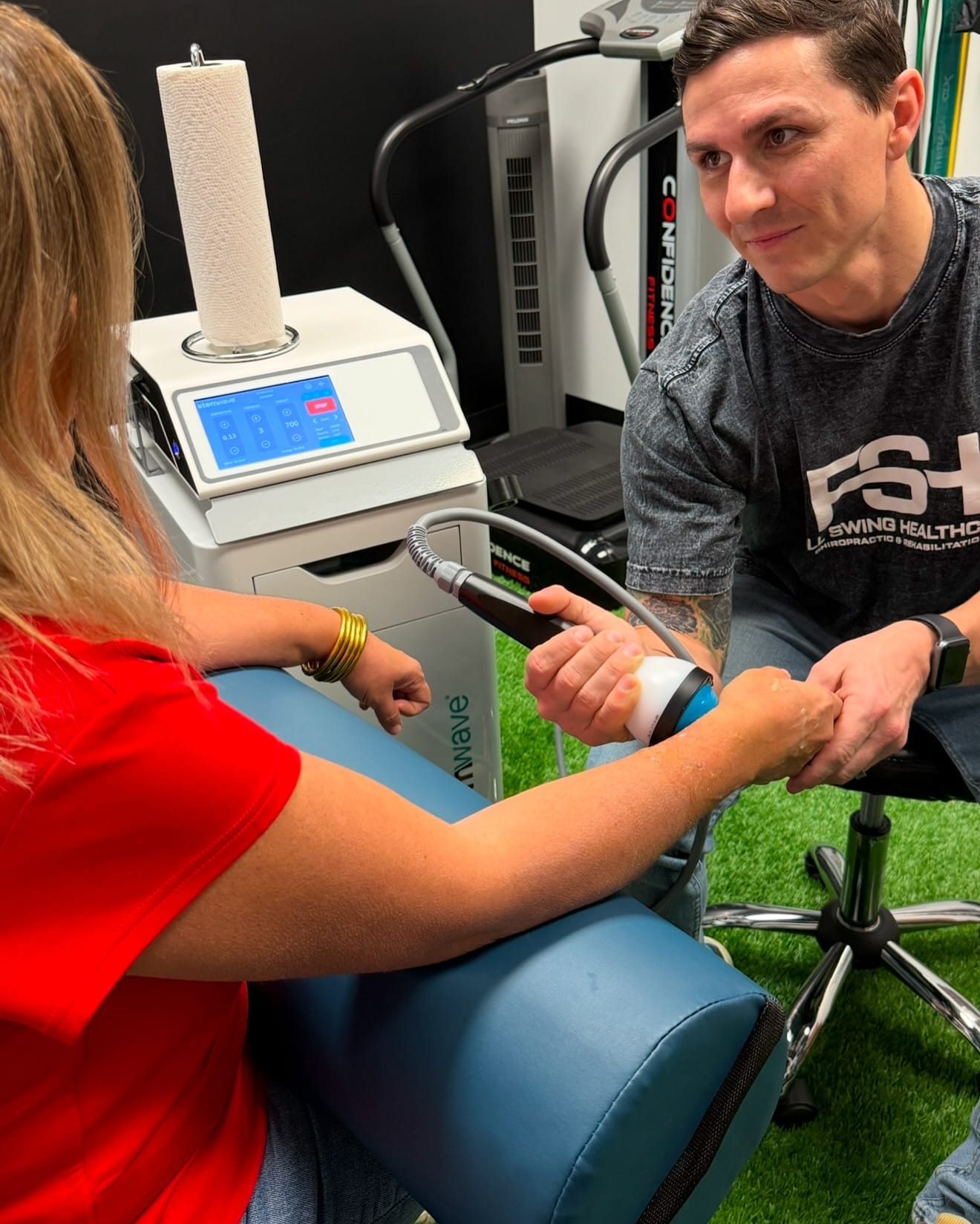
Full Swing Healthcare treats lateral hip pain, trochanteric bursitis and gluteal tendinopathy, with shockwave therapy right here in Jacksonville. If you’ve had cortisone injections that worked for a while and then stopped, shockwave combined with correcting hip mechanics is typically what finally produces lasting relief.
Why “Hip Bursitis” Is Often More Than Just a Bursa Problem
What most people call trochanteric bursitis is increasingly recognized in the research as gluteal tendinopathy: specifically degeneration of the gluteus medius and minimus tendons where they attach at the greater trochanter. The bursa does get inflamed, but it’s usually a secondary reaction to the tendon problem, not the root cause. Cortisone injections target the bursa and can quiet things down temporarily, but they don’t address the tendon degeneration driving the chronic pain, which is why relief tends to wear off.
Shockwave delivered over the greater trochanter works on both issues at once. The acoustic energy targets the degenerative tendon tissue directly, stimulates repair at the tendon-bone interface, and reduces the secondary bursitis by improving overall tissue health in the area.
The Compressive Loading Problem
Lateral hip tendinopathy is uniquely sensitive to compressive forces across the greater trochanter. If you notice your pain is worse when crossing your legs, sleeping on the affected side, or climbing stairs, that’s compression aggravating the tendon. Effective treatment has to address that load pattern, not just the tissue.
Alongside shockwave sessions, we walk you through specific movement and sleeping position changes that reduce compressive load during the recovery window. Getting both pieces right is what makes results stick.
Who We See Most Often
Lateral hip pain shows up most frequently in women over 40 and in runners who’ve built up training volume faster than their hip abductor strength could keep pace with. We see both groups regularly at our Jacksonville Beach office. If you’ve had a string of cortisone shots that helped less and less each time, that pattern tells us the tendon degeneration is the real driver, and that’s exactly what shockwave addresses.