
A sports injury chiropractor in Jacksonville is who you want in your corner when a strain, sprain, or nagging overuse injury threatens to sideline your season. Whether you tweaked a shoulder paddling out at the Beaches, rolled an ankle on a sunrise run, or pulled something deep in your lower back chasing a long drive at Ponte Vedra, Full Swing Healthcare assesses the real cause first, then combines chiropractic with the right recovery tools to get you back in the game, faster.
Sports injuries we see most
Active bodies break down in fairly predictable ways, and most of what walks through our door on Beach Blvd falls into a handful of buckets. The injury usually tracks the sport, but the underlying tissue problem is often the same story told a few different ways:
- Muscle strains: an overstretched or torn muscle or its tendon, common in the hamstrings, calves, groin, and lower back after an explosive move or a missed warm-up
- Ligament sprains: a rolled ankle, a jammed knee, or a wrist caught wrong on a fall, where the ligament that stabilizes the joint gets overloaded
- Tendinitis and tendinopathy: an irritated, degrading tendon from repeated load, think Achilles, patellar (jumper’s knee), rotator cuff, or tennis and golfer’s elbow
- Overuse injuries: shin splints, plantar fasciitis, IT-band syndrome, and stress reactions that build quietly from too much volume, too soon
- Joint and disc irritation: lower-back and neck pain from the repeated rotation and impact of golf, tennis, lifting, and running
“Dr. Cody Muren truly understands sports, fitness, and overall wellness. He focuses on finding the root cause, not just quick fixes, and helps you move, feel, and perform your best.”
MN Marisa Norse
Google review
How the injury tracks the sport
We treat the full range of active Jacksonville lifestyles, and the pattern of the injury usually points straight back to what you love doing.
Surfers load the shoulders, neck, and rotator cuff hard, all that paddling and pop-up leaves the shoulder cranky and the upper back tight. Recurring shoulder trouble is common enough that we built a dedicated page for it, see our shoulder pain care. Runners battle the classic overuse trio: shin splints, plantar fasciitis, and IT-band pain, plus Achilles and knee tendon overload from pounding hard-packed sand and pavement in real heat and humidity. Golfers and racquet players overload the lower back, hips, and elbows from repeated one-sided rotation, and a stiff mid-back often forces the low back to do work it was never meant to do. Lifters strain the lower back, shoulders, and elbows, usually when load outruns technique or recovery.
Underneath the specifics, most sports injuries come down to one of three things:
- Overuse: too much volume, too soon, without enough recovery between sessions
- Acute trauma: a fall, collision, awkward landing, or sudden twist that overloads tissue in an instant
- Movement faults: a stiff joint or a weak link forcing another area to overwork and eventually give out
Signs it is time to get it looked at
Rest has its place, but “I’ll just walk it off” turns a lot of two-week fixes into two-month ones. Come get it assessed if you are dealing with any of these:
- Sharp or nagging pain that flares with a specific movement (swinging, pushing, planting, paddling)
- Swelling, stiffness, or reduced range of motion in a joint
- A catch, click, or sudden weakness when you load the limb
- Recurring strains that keep returning to the same spot no matter how much you rest
- Lower-back or hip pain that shows up after rotational sports like golf or tennis
- Shin, heel, or foot pain from running that does not settle with a few easy days
- Numbness, tingling, or pain that radiates down an arm or a leg
Why the assessment comes first
We do not just chase the sore spot. Pain is where you feel the injury, not always where it started. A cranky knee can trace back to a stiff hip, an irritated shoulder to a locked-up mid-back, a strained hamstring to a pelvis that will not rotate cleanly. Your first visit is a real exam: we look at how the joint moves, how the surrounding muscle fires, and what is compensating for what. Only then do we build a plan. That is the difference between calming a symptom and fixing the reason it happened, which is also why the same strain stops coming back.
Multi-modality rehab under one roof
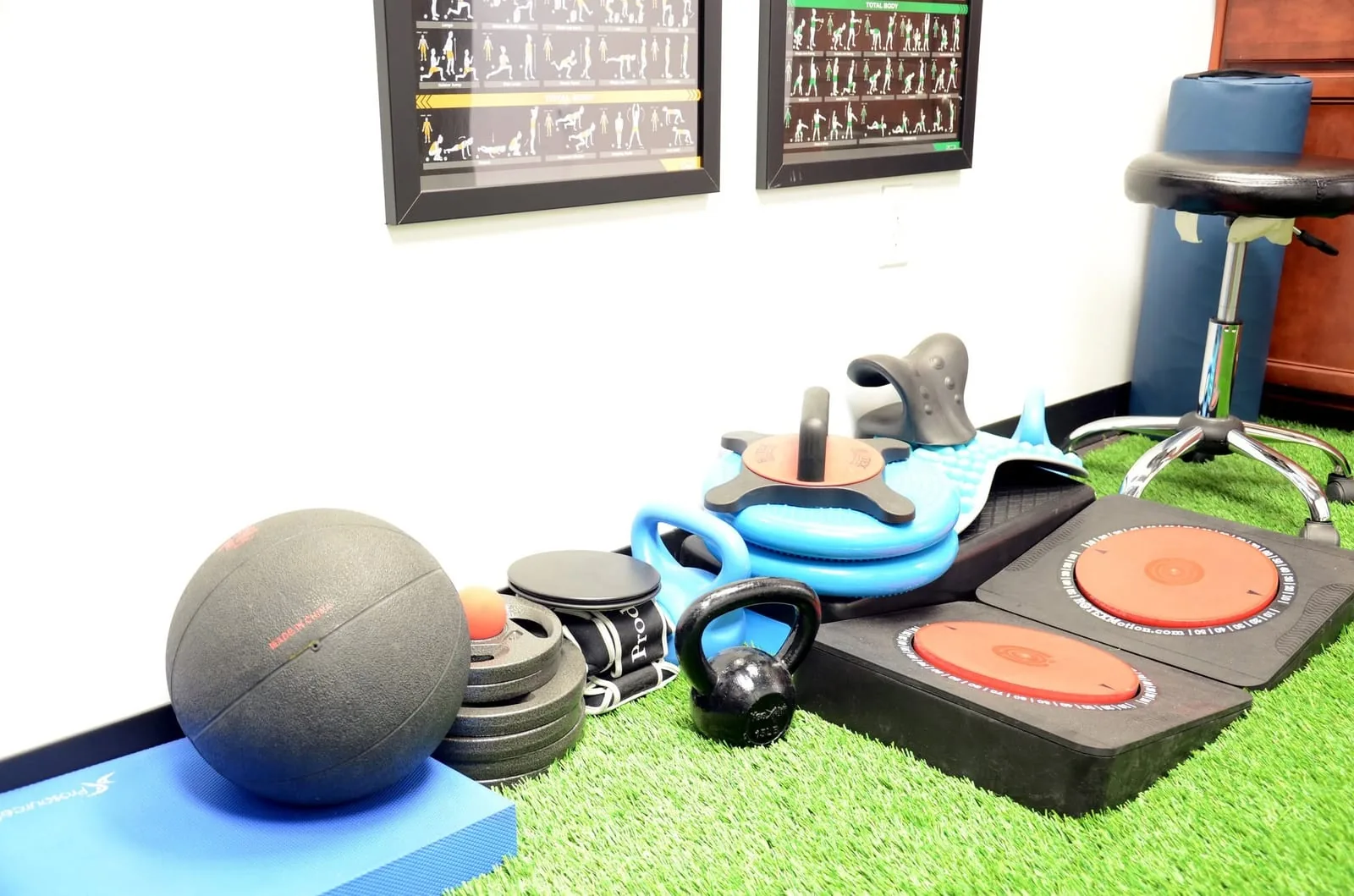
Once the exam tells us what is actually wrong, we pull from the whole toolbox instead of forcing one tool onto every problem. Combining the right modalities is what gets tissue healing faster than any single treatment alone.
Chiropractic adjustment
We restore motion to the joints that have stopped moving well and take pressure off the irritated tissue, so the injured area can actually settle and heal instead of guarding.
Targeted soft-tissue and recovery work
We layer in the right modalities for your specific injury. Dry needling releases the tight, knotted muscle holding a joint hostage. Shockwave therapy jump-starts repair in stubborn, degrading tendons and fascia that have stalled out. Myofascial cupping loosens restricted tissue and pulls fresh blood flow into the area to speed things along. Kinesiology taping goes on when a joint needs feedback or a tendon needs a little load taken off it between visits.
Rehab and return-to-play
Feeling better is not the finish line, staying durable is. We rebuild the strength, control, and movement quality around the injury so you can load it again with confidence and not re-tear it in week one. For structured, ongoing performance and prevention work between seasons, our athletic recovery section picks up where injury care leaves off.
Getting back to your sport safely
The most common way athletes reinjure themselves is returning on a calendar instead of on capacity. The tissue may feel fine at rest and still fail under a sprint, a cut, or a heavy swing. We stage the return: first we restore pain-free range of motion, then we rebuild strength through that full range, then we reintroduce speed, impact, and sport-specific load in steps. Along the way we show you what to watch for, how to warm up, and which movements to back off for now. The goal is not just an athlete who is out of pain, it is an athlete who trusts the limb again.
Return to play criteria are simply that judgement written down before you are emotionally invested in the answer. Full pain free range compared side to side. Strength within roughly ten percent of the uninjured limb, tested rather than guessed. The ability to hop, cut and change direction without hesitating, since guarding shows up in movement long before it shows up in a strength number. Sport specific drills completed at full speed with no next day flare. And honestly, confidence, because an athlete who does not trust a limb compensates with the rest of the body and injures something else instead.
RICE is out of date, and what replaced it
Most of us learned rest, ice, compression, elevation. The current guidance moved on, because prolonged rest and aggressive icing turn out to work against the very inflammatory process that repairs tissue. The replacement is remembered as PEACE and LOVE. For the first days, protect, elevate, avoid anti-inflammatories where you reasonably can, compress, and educate, meaning understand the injury instead of chasing passive treatments. After that, load, optimism, vascularisation, meaning get the heart rate up with movement that does not aggravate it, and exercise.
The practical translation is short: protect it early, then start loading it sooner than the old advice suggested, guided by symptoms rather than by the calendar. Ice for comfort in the first day or two is fine. Ice as a treatment plan is not.
“As a former college athlete, endurance competitor, and Army officer, my body had sustained a ton of injuries over the years. Full Swing Healthcare has been critical for my recovery.”
DO David Ochs
Google review
Don’t train through a real injury. Pushing through sharp pain or a strain that keeps returning usually turns a quick fix into a long one. Get a straight assessment first. Book online or call (904) 539-3352 and we will tell you exactly what is going on. Your first visit is $115 and includes the full exam.
Your sports injury clinic for Jacksonville and the surrounding areas
Full Swing Healthcare sits at 13770 Beach Blvd, which puts effective sports injury care within easy reach of the whole east side. We treat surfers and runners coming straight off the sand at Jacksonville Beach, Atlantic Beach, and Neptune Beach, golfers and tennis players driving up from Ponte Vedra Beach, and gym athletes and weekend warriors over in Southside who want the injury handled without a cross-town trek. Because chiropractic, needling, shockwave, and rehab all live under one roof here, you handle the whole injury in one place instead of bouncing between offices that never talk to each other. Same-day appointments are often available.
Sports injury questions
Do I need a referral to come in for a sports injury?
No. You can book directly with us, no referral needed. Your first visit is $115 and includes a full exam, and we accept Florida Blue, United Healthcare, Humana, Cigna, Florida Medicaid, and VA.
Should I see you for an acute injury or wait to see if it settles?
If you have swelling, sharp pain, weakness, or pain that radiates, get it assessed rather than guessing. Catching a strain or sprain early usually means a faster, fuller recovery. Same-day appointments are often available at our Jacksonville clinic.
How soon can I get back to my sport?
It depends on the injury and how it responds, but we return you on capacity, not on a guess. Once you have pain-free range of motion and rebuilt strength, we reintroduce speed and sport-specific load in stages so you do not reinjure it. After your exam we give you an honest, realistic timeline.
What if I want to prevent injuries, not just treat one?
That is a different goal, and we have a dedicated path for it. Our athletic recovery care handles proactive performance and prevention: keeping joints moving well and weak links strong so the same strain stops flaring. Come in for the injury, and we can build maintenance into your plan from there.
Which clinic in Jacksonville treats running injuries?
We treat running injuries, and we approach them differently than most clinics. Instead of chasing the painful spot, we evaluate the mechanics above and below it, because most running injuries are a loading problem, not a tissue problem. Fix the mechanics, and the tissue finally gets a chance to heal.
Can a chiropractor in Jacksonville help with pickleball injuries?
Yes, pickleball injuries are one of the most common things we treat at Full Swing Healthcare. The sport’s rapid direction changes, repetitive paddle mechanics, and the age range it attracts create a consistent injury pattern we know well. Most players are back on the court in weeks, not months.