
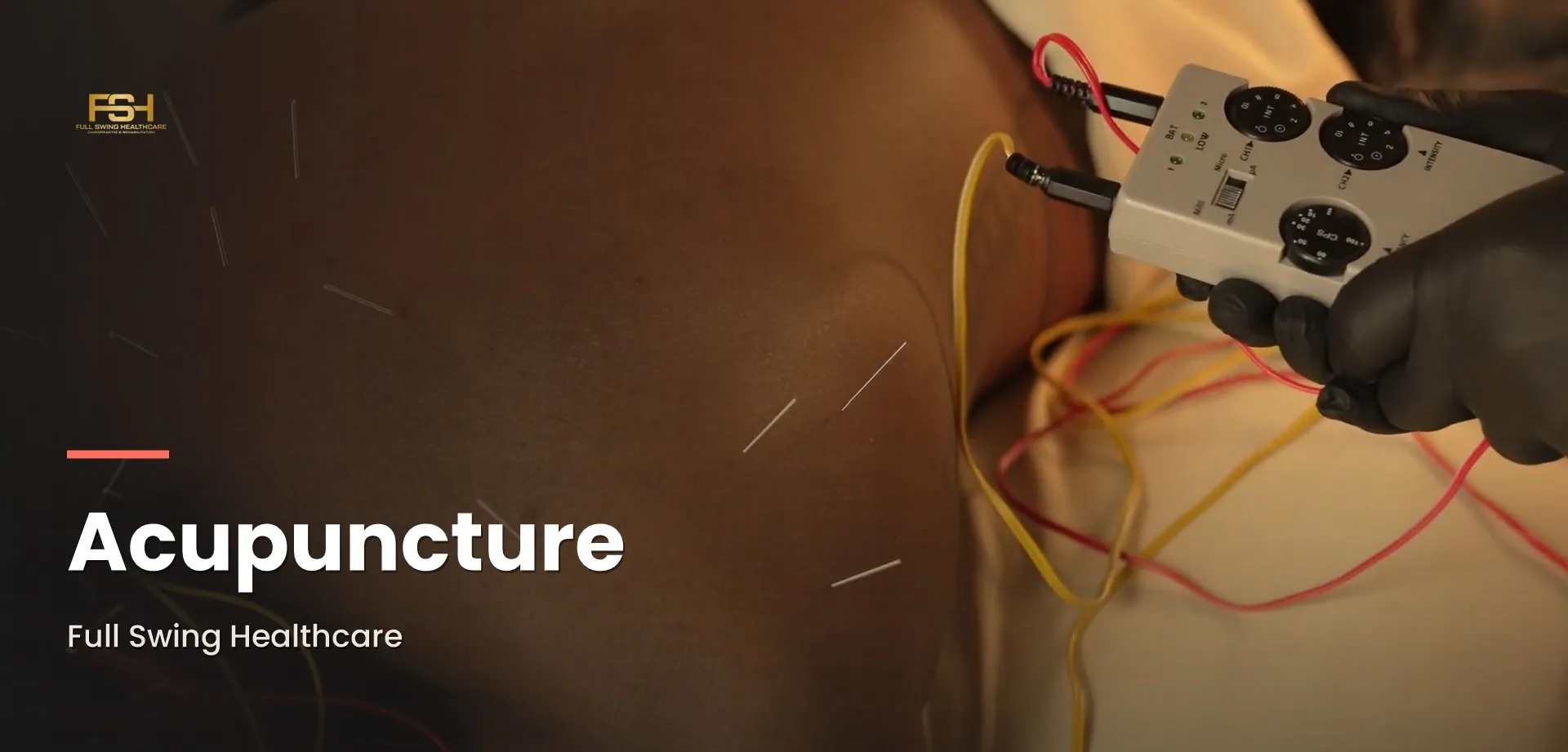
Done right, acupuncture isn’t mystical, and it isn’t a placebo. It’s a precise, drug-free way to calm angry nerves, release tight muscle, and turn the dial down on pain. At our Jacksonville clinic, Dr. Muren uses it as a clinical tool, not a spa add-on: part of a real plan, alongside your chiropractic and rehab care, so the relief actually sticks.
How acupuncture actually works
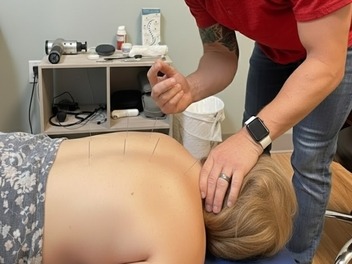
Hair-thin sterile needles are placed at specific points in muscle and connective tissue. Your body reads that input as a signal to do three useful things: increase blood flow to the area, release your own natural pain-dampening chemicals, and quiet the overactive nerves that keep a muscle locked in spasm or a headache pounding. There’s no medication and nothing you have to “believe in.” It’s simply your nervous system responding to a targeted nudge.
That’s why we like it as a teammate to chiropractic. An adjustment restores motion to a joint; acupuncture settles down the soft tissue and pain signaling around it. A back locked in protective spasm often isn’t ready to adjust, so we calm it first with acupuncture, and the adjustment then holds better and longer. Together they tend to give you faster, longer-lasting relief than either one alone.
“I have been receiving acupuncture from Dr. Muren for the last couple of months and I’m extremely happy with the results. When I first came in I couldn’t turn my head without pain. My range of motion has improved so much.”
SW Sara W.
Jacksonville
Two approaches, one goal
Not all acupuncture is the same, and the difference matters for what you’re dealing with. Dr. Muren is trained in both of the main frameworks and picks based on what you actually walk in with:
- Orthopedic acupuncture targets points chosen by anatomy: the specific muscles, tendons, and nerves driving your pain. It’s the right tool for musculoskeletal problems like a stiff neck, a cranky shoulder, or sciatica.
- Traditional Chinese acupuncture uses the classic meridian approach, better suited to whole-body issues with a systemic thread: stress, poor sleep, and tension that lives everywhere at once.
Plenty of people need a bit of both in the same plan, and you don’t have to buy into any philosophy for it to work. The physical effects happen regardless.
De Qi, and the points you are most likely to get
The dull, heavy, spreading ache people notice when a needle is placed well has a name: De Qi. It is not pain, it fades within seconds, and it is the sensation practitioners are aiming for because it signals the needle has reached the right tissue depth. If you feel nothing at all, that is common too and does not mean the session failed.
Points carry both a traditional name and a channel code, and a handful come up constantly in musculoskeletal work. LI4, Hegu, sits in the web of the hand between thumb and index finger and is a workhorse for head, neck and jaw complaints. GB30, Huantiao, sits deep in the buttock near where the sciatic nerve passes and is standard for radiating leg pain. BL40, Weizhong, sits in the crease behind the knee and is used for low back and hamstring involvement. Points are frequently chosen away from where it hurts, which is why a neck complaint may be needled at the hand.
The variations you may get in a session
Needles are the baseline, and a few named variations sit on top of them.
- Electroacupuncture: small clips carry a gentle, low level current between two needles once they are placed. You feel a light tapping or buzzing, adjusted to your comfort. It is used where a sustained neuromuscular effect is wanted rather than a single input, which suits deep muscle along the spine and long standing pain.
- Auricular acupuncture: points on the outer ear, mapped as a microsystem of the whole body. Frequently added for stress, sleep and pain that is not confined to one region, and it is why a session for your back might include your ear.
- Battlefield acupuncture: a specific five point ear protocol, and the one variation that keeps working after you leave. Tiny semi permanent needles are seated in the ear and stay in place for several days, so the input continues between visits rather than ending when you get off the table. It was developed for the United States Air Force to give service members pain relief in the field without sedation, which is where the name comes from, and it is a common choice for pain that flares between appointments.
Which of these appear depends on what the assessment finds, and none of them change the session length or what you feel afterwards in any meaningful way.
Acupuncture and dry needling are not the same thing
Both use the same solid filament needle, which is where the confusion starts. The difference is the map. Dry needling is aimed strictly at a myofascial trigger point in a muscle that has been palpated and found tight, with a mechanical goal, releasing the taut band, often through a visible local twitch response. Acupuncture selects points from an anatomical or a channel framework, treats systemic patterns as well as local ones, holds the needles for twenty to thirty minutes rather than seconds, and can address things a trigger point model has no answer for, such as sleep and stress. For a single knotted muscle, dry needling is usually the faster route. For nerve pain, a pattern spread across several regions, or anything with a systemic thread, acupuncture is the better fit.
What acupuncture helps with
Acupuncture earns its keep across a range of the problems we see every week at the beaches. A few of the most common:
Headaches and neck tension
Tension and cervicogenic headaches often start in the tight band of muscle at the base of the skull and upper neck. Needling those points releases the guarding that refers pain up into the head. For patients already getting adjustments for headaches and responding, but not holding as long as they’d like, adding acupuncture on the same visit usually stretches out the time between flare-ups.
Low back pain and muscle spasm
For a low back locked up in protective spasm, acupuncture along the spine calms the deep muscle guarding and the pain signals coming off the joints. That matters clinically: a back in full spasm isn’t ready for an adjustment, but one that’s been settled with acupuncture first is. It’s a big part of why we combine the two.
Back pain isn’t one thing. It has layers, and acupuncture works on several of them at once: the muscle guarding your body locks in to protect an injured area, the pain sensitization that sets in when chronic pain rewires your nervous system so everything feels amplified, and the autonomic stress that accumulates around ongoing pain. If your back pain hasn’t fully resolved despite addressing the structure, these neuromuscular and autonomic layers are usually why.
Sciatica and nerve pain
Sciatica, that burning or shooting line of pain from the low back through the glute and down the leg, can come from a disc pressing on a nerve root or from a deep hip muscle (the piriformis) pinching the sciatic nerve. Acupuncture calms the irritation in both patterns, and paired with chiropractic decompression it tends to speed up nerve recovery more than either approach on its own.
Shoulder pain, rotator cuff and frozen shoulder
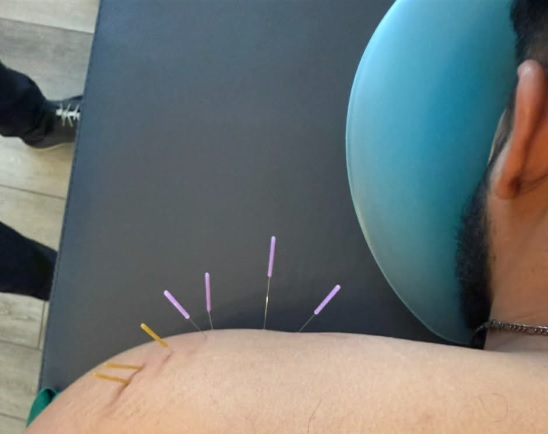
The shoulder responds especially well. For rotator cuff tendon pain, needling the affected tendons drives blood flow in to help them heal, a cousin of what shockwave does. For frozen shoulder, the needles quiet the joint enough that we can win back more range of motion during mobilization than we’d get otherwise.
Sports and overuse injuries
Nagging tendon pain, whether Achilles, knee, or tennis elbow, responds to a mix of local needling and a broader anti-inflammatory effect. That systemic piece matters here: Jacksonville athletes train year-round in real heat and humidity, and that constant load keeps inflammation simmering, so tendons flare faster and settle slower. Acupuncture works both the sore spot and the bigger inflammatory picture at once, and for a fresh muscle strain it eases the guarding that keeps you from moving and getting back to training.
Nerve pain and peripheral neuropathy
Burning, tingling, numbness or a pins and needles feeling in the feet and hands is one of the things people most often ask acupuncture about, usually after medication has taken the edge off without touching the numbness. It is worth being straight about what is known. The studies on peripheral neuropathy, most of them in diabetic neuropathy and in the nerve pain that follows chemotherapy, generally report improvement in symptoms and sometimes in nerve conduction measures, but the trials are small and the effect is symptom relief rather than a cure for the underlying nerve damage. Cause matters too: a compressed nerve root in the low back is a mechanical problem with a mechanical answer, which is a different conversation from a metabolic neuropathy. That is what the assessment sorts out before anyone commits to a course, and anything pointing at an undiagnosed or worsening cause belongs with your physician first.
Stress, sleep and whole-body tension
Outside of muscle and joint pain, this is where acupuncture has its strongest track record. A handful of well-studied points measurably shift your body out of fight-or-flight and into recovery mode, which shows up as calmer stress, better sleep, and less all-over tightness. When stress is quietly feeding your pain, treating both at once beats chasing the structural problem alone.
Your Jacksonville acupuncture clinic
Full Swing Healthcare sits at 13770 Beach Blvd, minutes from Jacksonville Beach, Atlantic Beach, and Neptune Beach, so quality acupuncture care stays close to home for the whole east side. Same-day appointments are often available, and because we keep acupuncture, chiropractic, and rehab under one roof, you can handle a combined visit in a single trip instead of driving all over town.

Who performs your acupuncture
Your acupuncture is done by Dr. Cody Muren, DC, a Palmer College graduate and certified acupuncturist trained in both orthopedic and traditional Chinese acupuncture. He’s one of the few practitioners around who brings acupuncture, chiropractic, shockwave, and soft-tissue work together on a single plan, instead of sending you to three places that never talk to each other.
Depending on what you need, he may use gentle electro-stimulation on the needles, ear (auricular) points, or targeted muscle-trigger needling. Every needle is sterile, single-use, and disposable. No exceptions.
What a session feels like
We assess first
True to how we do everything here, Dr. Muren figures out what’s actually driving your pain, and whether the orthopedic or traditional approach fits best, before any needles go in. No guesswork, no one-size-fits-all protocol.
The needles go in
They’re thinner than a strand of hair. Most people feel a tiny pinch or a dull, heavy ache at the point, and many feel nothing at all. That heavy sensation is normal and a good sign the point is working. It’s a world away from a shot at the doctor’s office.
You rest and let it work
The needles stay in for about 20 to 30 minutes while you lie still. This is the part patients are surprised by: it’s deeply relaxing, and plenty of people drift off.
You get up and go
No downtime. When it’s a combined visit, we’ll often do acupuncture first to prep the tissue, then your adjustment while everything’s relaxed. You might feel loose and a little mellow, or notice the relief build over the next day or two.
“I have been going to Dr. Muren for acupuncture for a little over a month. It helps tremendously with my neck, shoulders and back.”
LG Lisa Gaulin
Jacksonville
Is it safe? Yes. We use single-use, sterile, disposable needles every time, placed by trained hands, and side effects are minimal, usually just a little soreness or a small bruise at a point. A few situations call for extra care: if you’re pregnant, on blood thinners, have a bleeding disorder, or have an implanted electrical device like a pacemaker, tell us up front. Dr. Muren reviews your full health history first and adjusts the plan accordingly.
Acupuncture pairs well with the rest of your plan. We rarely use it as a stand-alone fix. Most patients get the best results when we combine it with a chiropractic adjustment and targeted rehab. That’s the whole-toolbox approach that gets the beaches back in full swing.
$115 first visit, exam included
$80 per acupuncture session
3 to 6 sessions for most issues
“I came here for acupuncture after being recommended for a pinched nerve in my neck, and felt immediate relief after just one session. I noticed the difference as soon as I walked out.”
OI Orlando Ibarra
Jacksonville
Pair it with
Acupuncture FAQs
Does acupuncture hurt?
For the vast majority of people, no. The needles are thinner than a strand of hair, far smaller than an injection needle, and going in is usually painless. You may feel a dull, heavy ache at a point, which is a normal sign it’s working, but most patients are surprised by how comfortable the whole session is.
How many sessions will I need?
Most acute and recent issues respond in about three to six sessions. Long-standing, chronic problems may need a longer initial run. After your assessment, Dr. Muren gives you an honest estimate based on what he finds.
Does insurance cover acupuncture in Florida?
It depends on your plan. Some Florida Blue, Humana, and United Healthcare plans cover acupuncture when it’s part of a medically necessary treatment plan. We verify your specific coverage before your first visit so there are no surprises.
Can I combine acupuncture with a chiropractic adjustment?
Absolutely, that’s exactly how we like to use it. We’ll usually do the acupuncture first to relax the muscle and calm the nerves, then the adjustment while everything’s receptive, so you tend to get faster, longer-lasting relief. Most patients who try a combined visit ask for it every time after.
Is acupuncture safe during pregnancy?
It can be, when done carefully by a trained practitioner who adjusts point selection for pregnancy. Let us know you’re expecting and we’ll tailor your care. Tell us too if you’re on blood thinners or managing any health condition.
Where can I get same-day acupuncture in Jacksonville?
Yes, Full Swing Healthcare offers same-day acupuncture appointments in Jacksonville when slots are available. The fastest way to land one is to call us in the morning at (904) 539-3352 . Our online booking shows scheduled availability but won’t reflect cancellations that free up throughout the day.
How do I choose the best acupuncturist in Jacksonville?
The best acupuncturist for you is one with the right credentials, a thorough intake process, and a training framework that fits your specific condition. In Jacksonville, that combination is rarer than you’d think, here’s exactly what to look for. Florida requires acupuncturists to be licensed by the Florida Board of Acupuncture, or to hold a DC or MD with additional acupuncture certification.
Chiropractic vs. acupuncture for back pain in Jacksonville
Both chiropractic and acupuncture can relieve back pain, but they work on different layers of the problem. Chiropractic targets the joint mechanics; acupuncture targets the pain signaling and muscle guarding around those joints. For most chronic back pain patients here in Jacksonville, combining both is what finally makes the difference.
What’s included in an acupuncture session in Jacksonville?
Every acupuncture session at Full Swing Healthcare follows the same arc: a brief intake or check-in, precise needle placement, a restful 20-to-30-minute retention period, and removal. First visits run 45 to 60 minutes. Return visits typically take 30 to 45 minutes, depending on what your body needs that day.
Where can I get acupuncture for shoulder pain in Jacksonville?
We offer acupuncture for shoulder pain that goes beyond the joint itself, we target the posterior rotator cuff muscles and cervical spine contributions that most clinics never evaluate. Many Jacksonville patients come to us after months of anterior-focused treatment that only partially worked, and they leave with real relief. The infraspinatus and teres minor sit on the back of your shoulder blade, but when they develop active trigger points, they refer pain into the front of the shoulder and down the lateral arm.