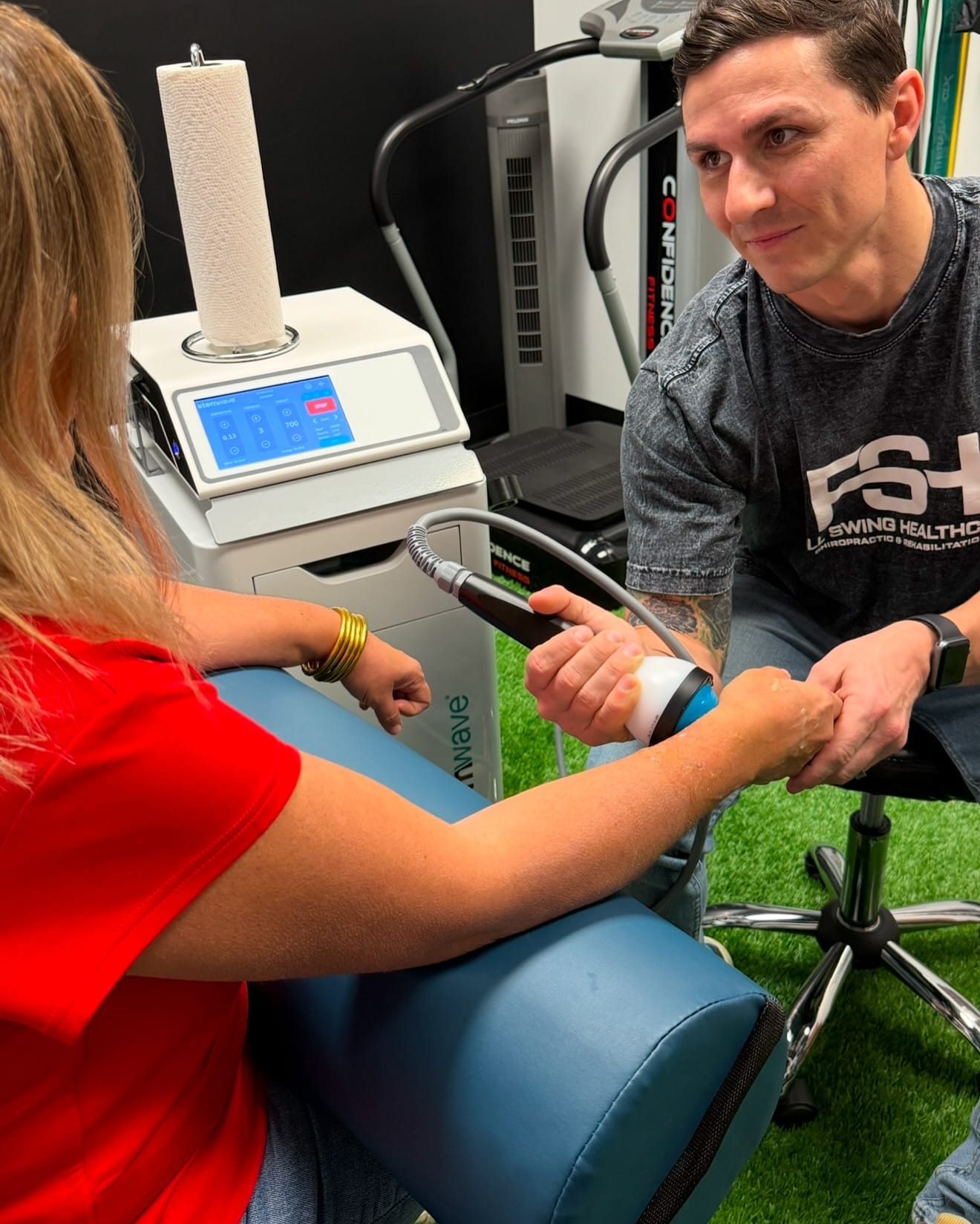
Yes, for the right rotator cuff conditions, shockwave therapy works well. It is most effective for supraspinatus tendinopathy and calcific tendinitis once the problem has moved into a chronic, degenerative phase. For acute tears or full-thickness structural tears, shockwave is not the right tool, and we will tell you that directly rather than take your money.
Supraspinatus Tendinopathy
The supraspinatus is the most commonly injured rotator cuff tendon, and it is the one we treat most often with shockwave here at Full Swing Healthcare. After three to four months of tendinopathy, the tendon’s insertion point on the humerus tends to shift from an inflammatory state to a degenerative one. Collagen becomes disorganized. Blood flow decreases. The tendon stops responding to load the way healthy tissue would.
Shockwave restarts that repair cycle. It stimulates fibroblast activity, promotes collagen synthesis, and drives new blood vessel formation into tissue that has gone quiet. That is exactly the mechanism that produces durable improvement in chronic rotator cuff cases where physical therapy alone has plateaued.
Calcific Tendinitis
Calcific tendinitis is one of the strongest evidence-based applications for shockwave therapy. The calcium deposits inside the supraspinatus tendon, the ones showing up on your X-ray, are broken down through the cavitation effect of the sound waves, while the surrounding tissue repair is stimulated at the same time. Some patients who were told surgery was the next step have avoided it entirely after a course of shockwave. That is not a promise, but it is a real outcome we have seen.
Why We Also Address the Mechanics
Rotator cuff problems rarely exist in isolation. Thoracic hypomobility, restricted cervical mechanics, and scapular dyskinesis all change how the cuff loads with every arm movement. If those drivers are not addressed alongside the tendon, the newly stimulated tissue gets reloaded in exactly the same dysfunctional pattern between sessions.
- Shockwave targets the degenerative tendon or calcific deposit directly
- Chiropractic adjustments correct thoracic and cervical restrictions that alter shoulder mechanics
- Corrective exercise addresses scapular positioning and rotator cuff loading patterns
- Bring your MRI or ultrasound report if you have one, it helps us plan the right approach from day one