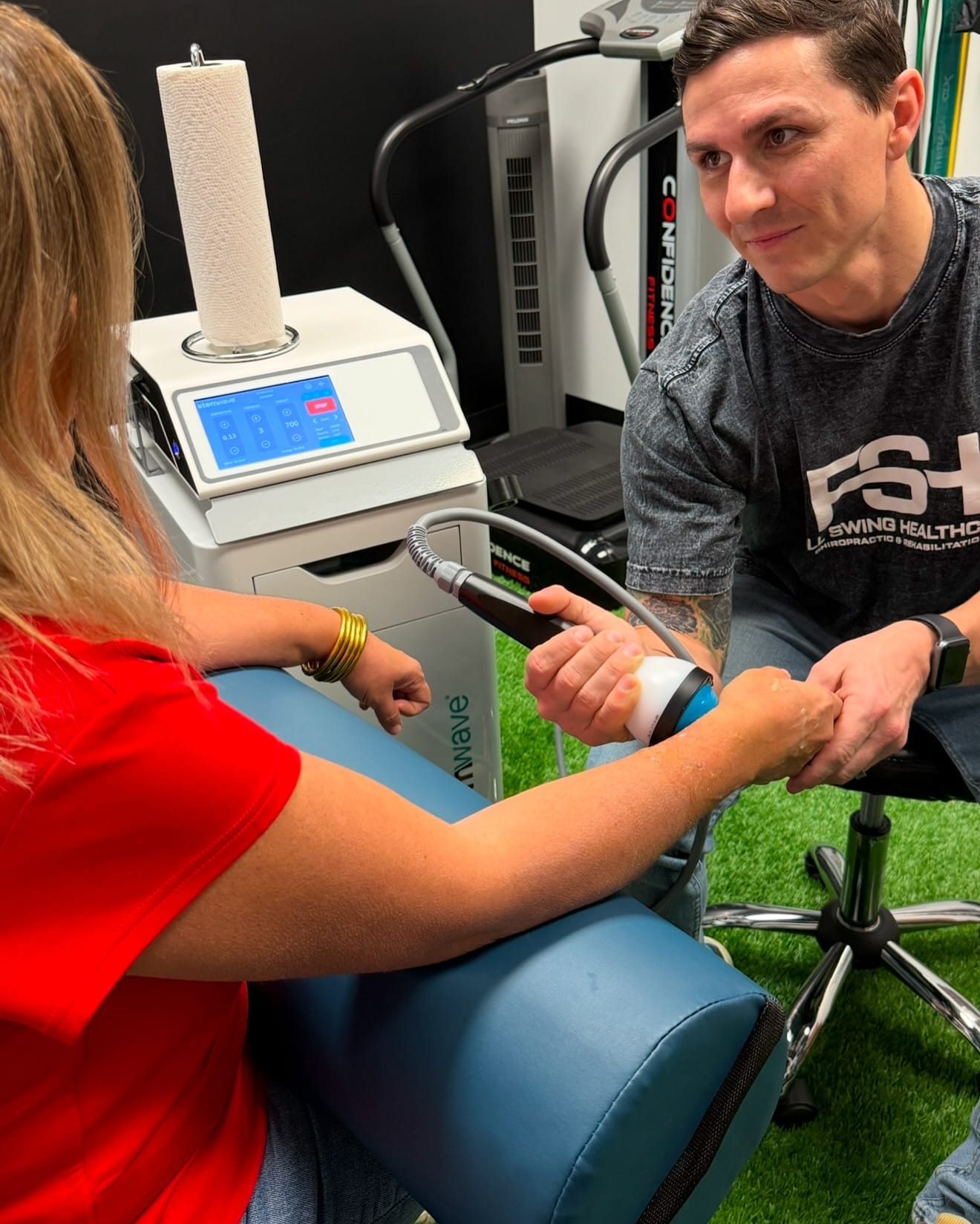
Full Swing Healthcare offers shockwave therapy for knee pain right here in Jacksonville, and it works best for two specific conditions: patellar tendinopathy and chronic IT band syndrome. If you’ve been doing rehab for months and the knee just won’t budge, shockwave is often the next step worth taking.
Patellar Tendinopathy (Jumper’s Knee)
Patellar tendinopathy is the go-to overuse injury for runners, cyclists, and athletes who do a lot of jumping. The telltale signs are pain right at the bottom of the kneecap that flares up on stairs, after a long run, or when you stand up from a chair.
In the early weeks, a structured eccentric loading program usually does the trick. But after three to four months without real progress, the tendon shifts from an inflammatory state to a degenerative one, what clinicians call tendinosis. At that stage, exercises alone rarely finish the job. Shockwave delivers focused acoustic energy directly into the tendon, stimulating the healing response that stalled out. It’s the most effective conservative option we have for chronic patellar tendinopathy.
IT Band Syndrome at the Knee
IT band pain at the outside of the knee is technically a compression problem, not a pure tendinopathy, but the connective tissue at that lateral femoral condyle responds well to shockwave once the condition has become chronic.
Here’s the catch: treating the IT band without looking at the hip is treating the symptom, not the problem. We always pair shockwave with an assessment of your hip mechanics, because a weak or poorly moving hip is almost always driving the lateral knee load in the first place. Fix the movement, then clear the tissue, that combination sticks.
A Real Example From the Beaches
A triathlete from the Beaches came in with bilateral patellar tendinopathy that had been limiting her training for four months. She had already completed a full course of physical therapy, including a proper eccentric loading program. The tendons had improved but hit a wall. Five sessions of shockwave combined with chiropractic correction of her hip mechanics got her back to full training. Her words afterward: she wished she had come sooner instead of grinding through exercises that had stopped producing results.
What About Degenerative Knee Pain?
Osteoarthritis is a different picture. Shockwave can have a role in some arthritic presentations, but the assessment is more involved and not every case is a good fit. If you have a known arthritis diagnosis and are curious whether shockwave makes sense for you, call us at (904) 539-3352 and describe what’s going on. We’ll give you a straight answer before you ever drive in.