
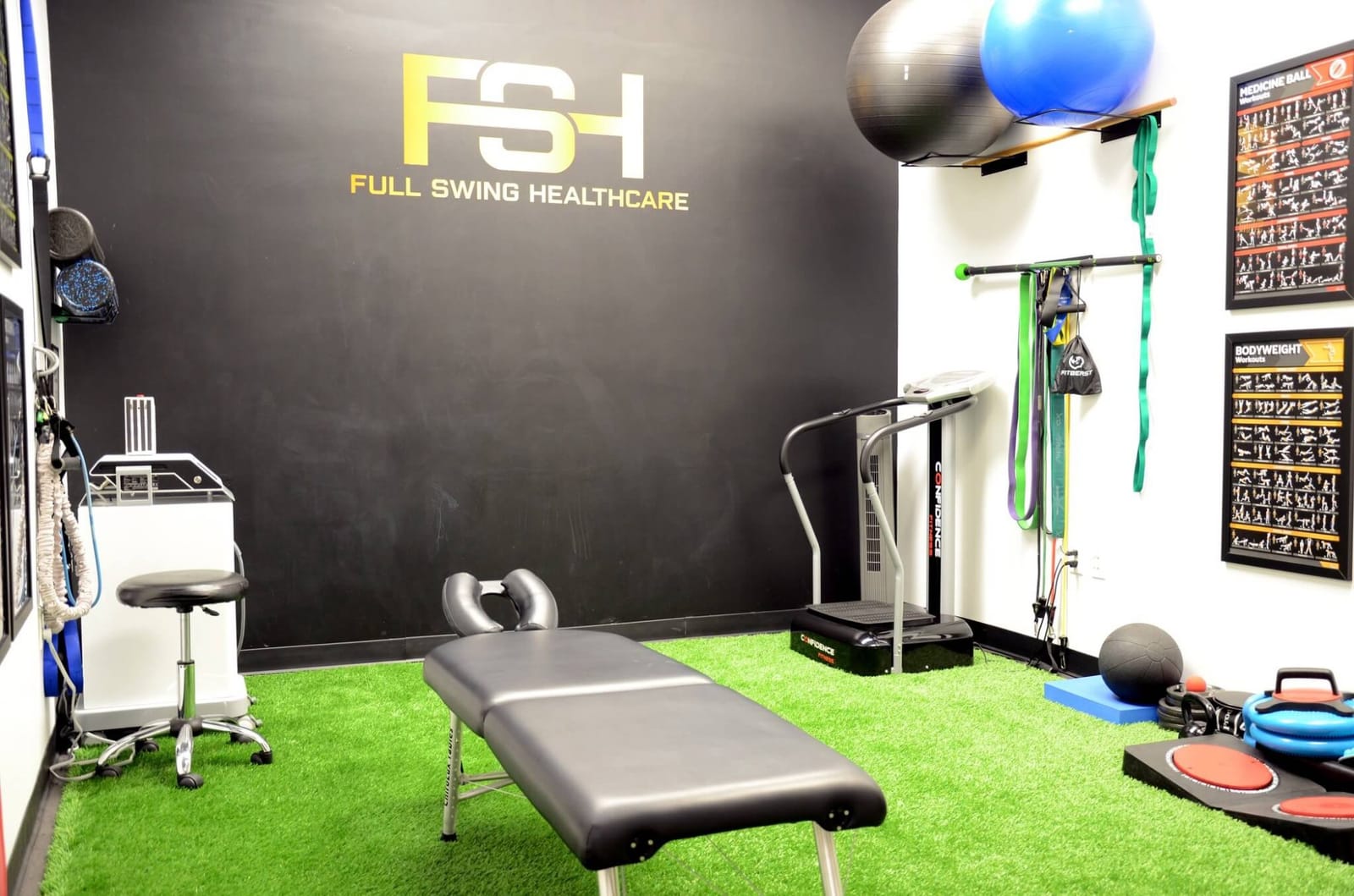
Full Swing Healthcare on Beach Blvd offers dry needling for knee pain right here in Jacksonville. We don’t just treat the knee, we assess the whole kinetic chain, because the hip and foot mechanics loading the knee are usually part of the story.
Why Trigger Points Matter for Knee Pain
Muscle trigger points are a surprisingly common driver of knee pain, especially for runners, cyclists, and anyone doing lateral-movement sports. A few key culprits:
- Vastus lateralis and TFL: tight and reactive in cyclists and runners, these muscles alter how the kneecap tracks and set off patellofemoral (front-of-knee) pain.
- Popliteus: a small muscle tucked behind the knee that refers pain every time you flex the knee: stairs, cycling, squatting.
- Proximal gastrocnemius: when the upper calf attachment develops trigger points, the referred pain lands in the back of the knee and is often mistaken for a posterior compartment problem.
These muscle-driven patterns can exist on their own or alongside joint-level issues. We assess both and treat whatever is actually driving your pain. Combining dry needling of the muscular contributors with chiropractic correction of hip and SI mechanics, when that is the underlying loading problem, consistently produces better outcomes than either approach alone.
The IT Band Situation (This Comes Up a Lot)
If you have lateral knee pain, you have probably been told your IT band is tight. Here is the honest explanation: the IT band itself is dense connective tissue. It does not develop trigger points the way muscles do, which is why foam rolling directly on it rarely gives lasting relief. The muscles that feed into it, the TFL at the hip and the fascial contribution from the gluteus maximus, are where the active trigger points live. That is where the needle goes. Treating the actual driver gives you results that compression on the band cannot.
A Local Example
A cyclist from the Southside came in with bilateral knee pain that months of foam rolling and stretching hadn’t touched. Dr. Muren needled the bilateral TFL and vastus lateralis. The lateral knee pain that had been limiting his training cleared within three sessions. We also found and corrected a left SI joint restriction creating pelvic asymmetry, which was changing how both knees loaded through every pedal stroke.