
Carpal tunnel relief in Jacksonville starts with finding out where the nerve is actually being squeezed. Numb fingers, a tingling hand that wakes you at night and a grip that keeps dropping things usually get blamed on the wrist, and often that is right. Just as often the forearm muscles or the neck are part of the story, and treating only the wrist is why so many people end up living in a brace.
What carpal tunnel actually is
The carpal tunnel is a narrow passage on the palm side of your wrist, walled in by the small wrist bones and roofed by a tough ligament. The median nerve runs through it alongside the tendons that bend your fingers. When the space gets crowded, from irritated tendons, tight tissue or a wrist held bent for hours, the nerve gets compressed and starts to complain. It complains in a recognizable pattern:
- Numbness and tingling: in the thumb, index finger, middle finger and half of the ring finger, while the little finger usually stays normal
- Night symptoms: hands that go numb or burn during sleep and need shaking out before they wake up
- A weaker grip: jar lids, coffee mugs and car keys that suddenly feel harder to hold on to
- Clumsy fingers: trouble with buttons, earrings or typing accurately
- Pain that travels: an ache that can spread from the wrist into the palm or up the forearm
- Worse with certain tasks: driving, holding a phone, typing or gripping a tool for long stretches
Why the wrist is not always the whole problem
The median nerve starts in your neck, runs down through the shoulder and the forearm, and only then passes through the wrist. It can be irritated anywhere along that route. A nerve root in the lower neck can send tingling into the same fingers carpal tunnel does, and a tight band of forearm muscle can load the nerve before it ever reaches the wrist. When a nerve is under pressure in two places at once, each spot makes the other worse.
That is why a carpal tunnel exam here checks the neck and the forearm, not just the wrist you are rubbing. If the neck turns out to be involved, our neck pain page explains how that part gets treated.
Who gets carpal tunnel
We see it most in people whose hands do the same thing all day. Keyboard and mouse work, repetitive gripping in the trades, fine motor jobs and long drives all load the forearm in a sustained clench. Hairdressers, dental hygienists, mechanics, warehouse pickers and anyone on a laptop from morning to evening fit the pattern. Pregnancy can bring it on too, because extra fluid crowds the tunnel, and it often eases after delivery.
If your symptoms started on the job, the visit may be covered. Our work injury chiropractor section explains how workers’ compensation works here.
How we treat carpal tunnel without surgery
After the exam we treat every spot that is feeding the nerve, which usually means the soft tissue of the forearm and hand, joint motion at the wrist and elbow, and the neck when it is involved.
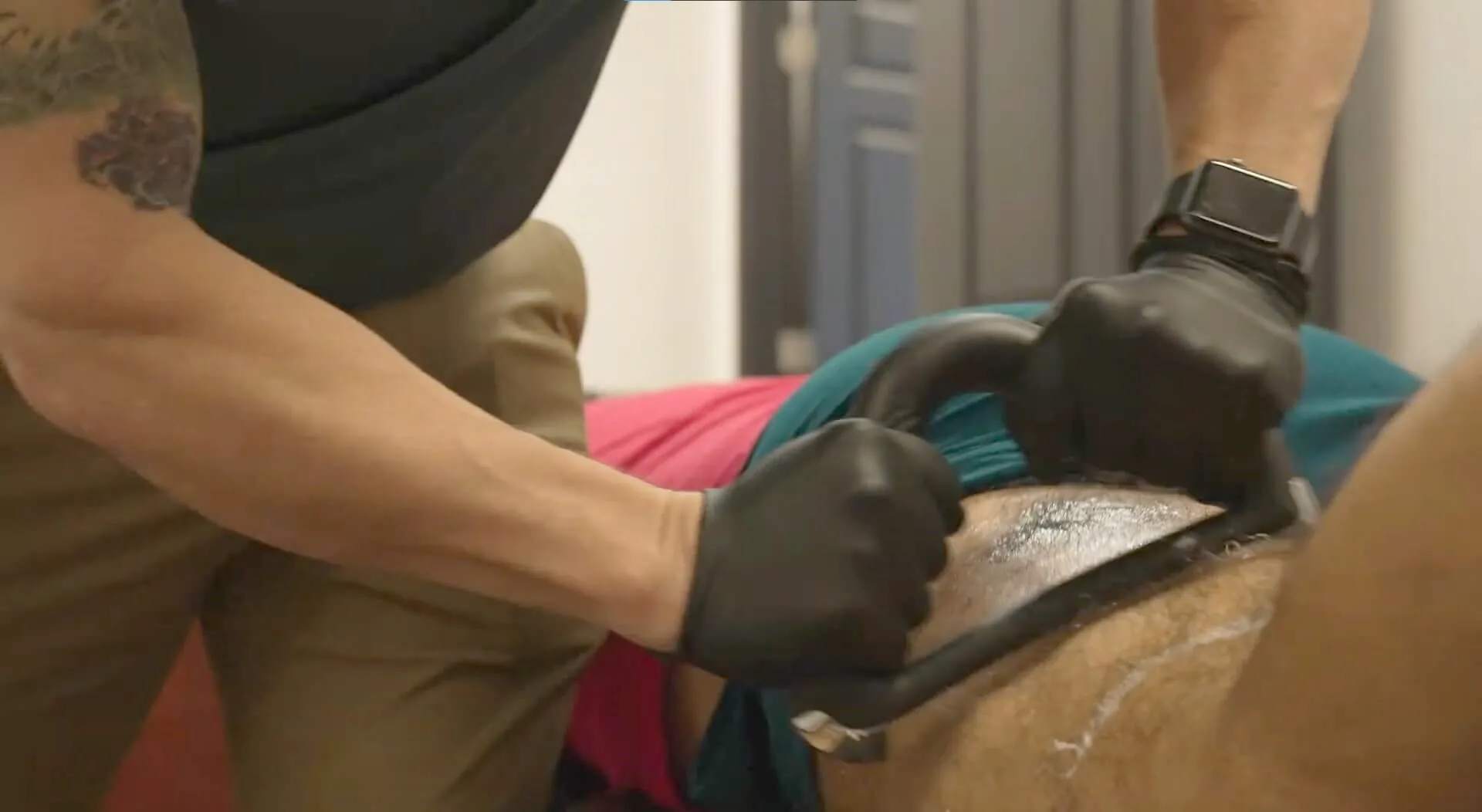
Myofascial scraping
Carpal tunnel compression is often driven by fascial restriction in the forearm flexors, loading the tunnel with every grip and keystroke. A stainless steel instrument breaks up those restrictions so the tissue slides freely again. See myofascial scraping.
Dry needling
Trigger points in the forearm and in the muscles that hold the wrist bent get released directly, which takes load off the nerve where hands alone cannot reach. See dry needling.
Wrist, elbow and neck adjustments
Gentle work restores motion to the small wrist bones, the elbow and, when it is part of the picture, the lower neck. See chiropractic adjustments.
Load and habit changes
We look at how you type, grip and sleep, and give you a short list of changes and nerve gliding exercises so the problem stops getting fed between visits.
When carpal tunnel needs a specialist
Conservative care helps a lot of carpal tunnel cases, and it cannot help all of them. Numbness that never lets up, weakness that keeps getting worse, or wasting of the muscle at the base of the thumb means the nerve has been under pressure for a long time. If your exam looks like that, we will tell you and refer you for a nerve conduction test or to a hand specialist rather than keep treating something that needs a different answer.
Don’t wait until your hand stays numb. Early carpal tunnel responds far better than a nerve that has been squeezed for years. Same-day appointments are often available. Call (904) 539-3352 and we’ll find out where the pressure is coming from.
Carpal tunnel relief for Southside, Baymeadows and Deerwood
Full Swing Healthcare is at 13770 Beach Blvd #4, an easy drive from the offices of Southside, Baymeadows and Deerwood where so much wrist and hand pain starts. Patients also come to us from San Marco and the Beaches. Wrist and forearm problems respond to steady care over a few weeks, so a clinic close to work or home is one you actually keep coming back to.
What to do before your appointment
Keep your wrist straight at night; a simple brace that holds it neutral while you sleep often calms the night tingling. Take a short break from typing or gripping every half hour and let your hands hang loose. Set your keyboard so your wrists are not bent up or down, and loosen your grip on the steering wheel, the phone and the mouse. A brace can quiet the symptoms, but it does not change what is squeezing the nerve, which is what the visit is for.
Carpal tunnel questions
How do I know if it’s carpal tunnel or a pinched nerve in my neck?
Carpal tunnel usually spares the little finger and gets worse at night or with gripping. A nerve in the neck more often comes with neck stiffness, pain that runs down the whole arm, or symptoms that change when you turn or tilt your head. The two can also happen together, which is why the exam checks both.
Can carpal tunnel get better without surgery?
Many mild and moderate cases do, especially when the forearm, the wrist and your work habits are all addressed. Numbness that has been constant for a long time, real weakness or muscle loss at the thumb are signs surgery may be the right answer, and we will say so if we see them.
Should I wear a wrist brace?
A brace worn at night that keeps the wrist straight is a reasonable way to calm symptoms while you get treated. On its own it quiets the problem without touching the cause, so it works best alongside care for the forearm and the wrist.
Do I need a referral or insurance to be seen?
No referral needed, just call or book online. We accept Florida Blue, United Healthcare, Humana, Cigna, Florida Medicaid, and VA benefits, and we’re happy to verify your coverage before you come in.